KartRider Rush+
- 3.8
- Rating
- 10.00M
- Installs
- Free
- Price

 Analysis by App-foxy
I approached KartRider Rush+ as the kind of racing game I could pick up for a few quick matches, then gradually take more seriously. That first impression is accurate, but it misses the interesting part: the game rewards repeatable habits. Winning is not only about choosing a fast kart or reacting quickly. It is also about learning how each track flows, setting up controls that feel natural, and avoiding small mistakes that become expensive in a close race.
Developed by NEXON Company, this free racing game is aimed at a broad audience and carries an Everyone age rating. It has attracted over ten million installs, so finding other players is a central part of its appeal. The experience is built around real-time kart racing, but it also has enough depth for players who enjoy practicing the same course until a corner, shortcut, or boost sequence finally feels consistent.
How I settled into the racing routine
My usual session begins with a simple goal: play a few races without changing everything at once. That matters because the controls can feel busy when you are still learning. Steering, drifting, boosting, and watching the track all compete for attention. Rather than trying to master every technique immediately, I found it more useful to concentrate on clean driving first. Staying on the road and entering corners with a plan usually helped more than forcing a risky drift.
You May Also Like

 Blood Strike: 2.5 Anniversary
Blood Strike’s Loadouts Turn Every Drop Into a Tactical Gamble
A close look at Blood Strike’s custom loadouts: how fast access to signature weapons reshapes its battle royale rhythm, rewards preparation, and narrows the gap between fights.

 Pandora - Music & Podcasts
Pandora’s Music Is Easy to Start, but Harder to Recover
Pandora’s strength is its low-effort path from a seed to a station. Its weak spot is how much confidence it asks you to place in connection, setup, and quiet recovery.

 8 Ball Pool
 Is Built on Rivalries, Rematches, and Routine
A close look at the rivalries, rematches, shared routines, and unanswered safety questions that turn a quick pool match into a persistent mobile community.

 Samsung Music
’s Quiet Strength Is Playing What You Already Own
Its reach comes less from spectacle than from dependable access to a personal library. That simplicity is both the app’s strongest retention engine and its ceiling.

 AccuWeather: Weather Radar
AccuWeather Review: A Quick, Clear Forecast for Everyday Decisions
For everyday plans, the best forecast is the one you can understand quickly. AccuWeather makes rain timing, radar, and local conditions easy to act on, with a few trade-offs.

 Hill Climb Racing
Why Hill Climb Racing Still Turns Crashes Into One More Run
A tiny car, a bumpy hill and one more upgrade: Hill Climb Racing keeps resurfacing because its simple chaos makes every near-miss feel personal.
More From Our News Desk



The basic workflow is easy to understand. I choose a mode, race against other players or the game’s opposition, and use each result to identify one mistake. Sometimes that mistake is braking too late into a bend. Sometimes it is using a boost before the kart is properly aligned. This small review habit is more valuable than simply replaying a track on autopilot, because it turns a loss into a specific adjustment for the next attempt.
Short sessions suit the game well. I can play while waiting for an appointment or during a break, but the same structure also works for a longer evening session. The difference is that longer play makes fatigue more noticeable. When I start missing familiar corners, I take that as a sign to stop chasing one more win. Racing games often make players blame the kart or the matchmaking when the real problem is tired timing.
One everyday scenario where it works particularly well is a quick group session. A friend can join for a handful of races, and the competition remains understandable even if everyone has a different level of experience. A newcomer can focus on staying upright and learning the track, while a more experienced player can work on cleaner lines and more efficient boost use. That range gives the game more staying power than a racer that is only enjoyable once the controls are mastered.
The game’s current version is 1.37.8, and I would keep it updated before judging performance or control feel. A racing title depends heavily on a stable, responsive connection and consistent input behavior. If the game feels delayed, I would first check the local network and device workload before deciding that the driving model itself is poor.
Controls are the first serious decision
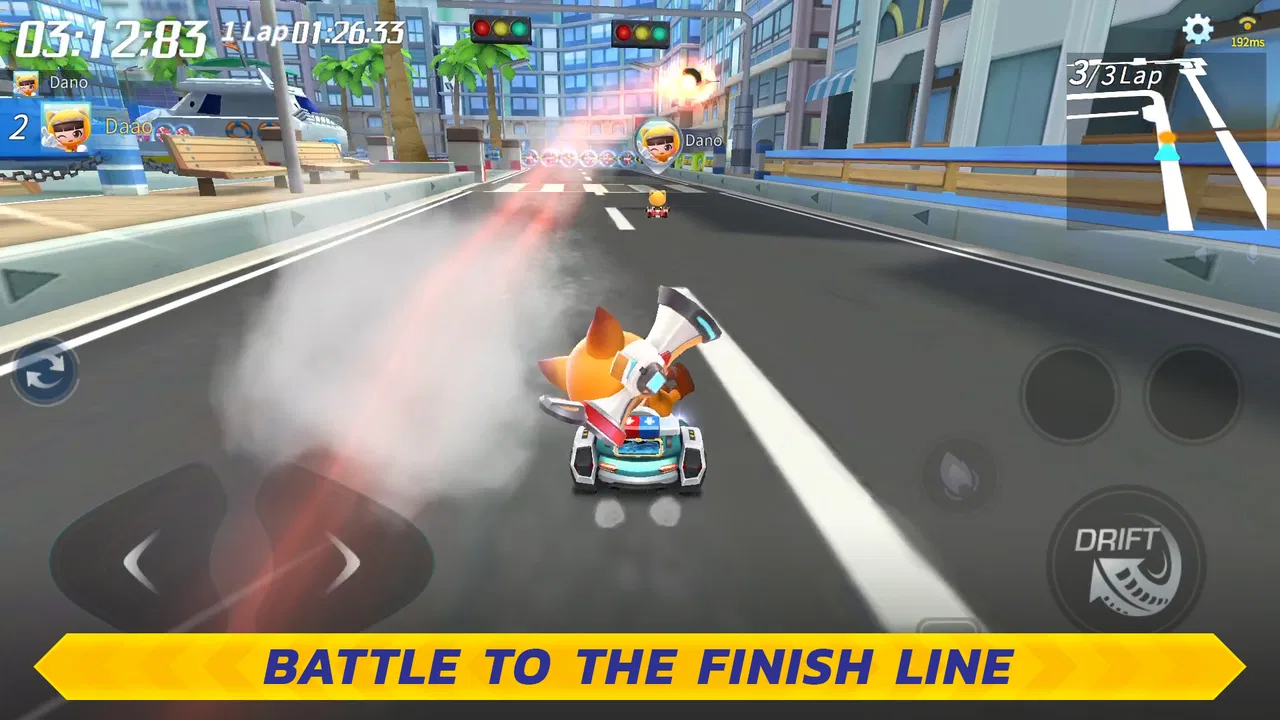
I recommend spending time with the available control options before entering competitive races. Touch steering can be convenient because it keeps everything on the screen, but it also demands more precision from your thumbs. Tilt-style control, where available in the game’s settings, may feel more natural to some players, although it can be awkward in a crowded room or while holding the phone at an angle. The best choice is not the one that looks most advanced; it is the one that lets you make the same correction repeatedly.
Virtual buttons deserve the same attention. I prefer a layout that keeps steering and drift actions within easy reach without forcing my hand to cover the racing view. A cramped arrangement makes accidental taps more likely, especially during a sharp turn. I also avoid changing the layout immediately after every poor race. I test one arrangement for several races, then decide whether the problem is truly the controls or simply unfamiliarity.
Visual comfort is another practical setting concern. Racing requires constant attention to the road, so anything that makes the screen harder to read can hurt performance. I look for a balance between clear track visibility and smooth play rather than automatically choosing the most demanding visual option. On a phone that is already warm or busy with other apps, a steadier experience is more useful than extra visual detail.
Audio can help with awareness, but I would not depend on it as the only source of information. Sound may make boosts and collisions easier to notice, yet the track itself still needs to be read visually. If I am playing in public, I can lower the volume without losing the fundamentals. That makes the game more flexible than a racer that expects players to keep audio loud at all times.
There is also a useful discipline in leaving cosmetic preferences separate from performance decisions. A kart or outfit may be more appealing visually, but I do not let appearance decide how I approach a track. I first learn what the selected vehicle feels like, then keep it long enough to understand its behavior. Constant switching makes it difficult to tell whether a race went badly because of a driving error or because I never adapted to the kart.
Small habits that make races cleaner
The fastest improvement I noticed came from treating corners as preparation points rather than emergencies. I try to enter a turn from a position that leaves room for the exit, instead of cutting in aggressively and hoping the kart will recover. This is especially helpful on unfamiliar courses. A slightly slower entry with a clean exit often produces a better next section than a dramatic drift that leaves the kart facing the wrong way.
Boost timing is another area where experienced play looks calmer than beginner play. I used to activate boosts as soon as they became available, but that often meant wasting speed before a bend or collision. Now I try to connect a boost with a clear stretch of track. The important habit is not saving every boost forever; it is using it when the kart can actually convert the extra speed into distance.
Drifting also becomes more useful when it is treated as a planned tool. Holding a drift through every possible turn can feel impressive, but it is not always efficient. On a wide, gentle bend, normal steering may preserve a better line. On a tighter corner, a controlled drift can help rotate the kart and prepare a boost. I focus on the exit rather than the visual effect of the drift itself.
Track memory gives regular players a major advantage. After a few attempts, I try to remember three things: where the first difficult corner arrives, where a boost is safe, and where recovery space is limited. That simple map is enough to reduce panic. I do not need to memorize every visual detail immediately. Knowing where I usually make a mistake gives me a clear target for practice.
Shortcuts are worth learning, but I would not assume that every alternative route is automatically faster for me. A shortcut that requires a precise entry can cost more time than the normal road if I miss it. My approach is to test it in a low-pressure race, then repeat it until the entry feels reliable. If I can only execute it once in several attempts, I treat the safer route as my real option during close competition.
Another useful pattern is to watch the space around the kart rather than staring only at the opponent directly ahead. A rival may be baiting a collision, blocking a line, or simply making a mistake that is about to create a hazard. Leaving a little room can feel slower for a moment, but it often prevents a chain reaction. In multiplayer racing, avoiding trouble is an active skill, not passive driving.
What experienced players should check before spending more time
The game is free to download and play, but it includes in-app purchases ranging from $0.99 to $74.99 per item. That is important for anyone who enjoys collecting or improving a game over a long period. I would decide on a personal spending limit before browsing optional items, especially because racing games can make visual upgrades and progression rewards feel closely connected even when the best purchase is simply no purchase.
For me, the sensible test is whether I still enjoy the driving when I ignore the shop. If the answer is yes, the game has a solid foundation. If the main motivation becomes acquiring the next item, the experience may start feeling less like racing practice and more like managing a collection. Players who want a completely purchase-free environment should keep that distinction in mind.
The average rating is 3.8 from around 414 thousand ratings, with roughly 3.2 thousand written reviews. I read that as a sign of a large but mixed audience rather than a universal recommendation. The game clearly works for many players, yet racing controls are personal. Some people will enjoy the quick, competitive format, while others will dislike the pressure of touch input or the learning curve that appears once opponents stop making beginner mistakes.
Its Everyone rating makes it approachable for a wide range of players, but approachable does not mean effortless. Younger or newer players may need time to understand drifting, boosts, and track positioning. I would introduce the game through casual races rather than immediately pushing someone into the most competitive environment. That gives the player room to learn without turning every early mistake into a frustrating defeat.
One limitation is that the game can ask for more attention than its colorful presentation suggests. A relaxed-looking kart racer still requires fast decisions, and a player who wants something completely passive will probably prefer a simpler arcade experience. It is also not the best choice for someone who only wants long, uninterrupted races; its quick-match structure is better suited to repeated attempts and gradual improvement.
Where it stands beside other mobile racers
Compared with a straightforward arcade racer, KartRider Rush+ offers more room for technique. The player is not merely steering around a track and waiting for a finish line. Drifting, boost timing, line choice, and track familiarity create a higher skill ceiling. That makes it more rewarding for someone who likes practicing a route, but less immediately relaxing than a game built around automatic handling.
Compared with a simulation-focused racing game, it is easier to approach and more playful in tone. I do not need to understand real-world vehicle setup to enjoy a race. The trade-off is that players looking for realistic physics, detailed car tuning, or a serious motorsport presentation may find this style too light. Its strength is responsive kart competition, not mechanical realism.
It also differs from a purely single-player racer because real-time competition changes the value of consistency. A perfect lap against no one can be satisfying, but racing other people creates pressure around positioning and recovery. That pressure is exciting when the connection is stable and the field is close. It can be frustrating when a mistake early in the race leaves little chance to recover, so players who dislike competitive uncertainty may prefer a solo-focused alternative.
I would recommend it to someone who wants a free mobile racing game that supports both quick matches and deliberate practice. I would be more cautious about recommending it to a player who dislikes in-app purchases on principle, expects every race to be evenly matched, or wants a game that can be played with almost no concentration. Those are not flaws everyone will feel, but they are meaningful boundaries.
My approach to long-term mastery
When I want to improve, I avoid changing several variables at once. I keep the same control layout, use a familiar kart for a while, and focus on one section of one track. That makes progress easier to recognize. If I alter the controls, vehicle, and route simultaneously, a better result tells me very little about what actually helped.
I also separate practice goals from winning goals. In one race, I may accept a poor finishing position because I am learning a difficult shortcut. In another, I may choose the safe route and concentrate on avoiding collisions. This distinction prevents practice from becoming discouraging. A failed experiment is useful when I know it was an experiment, rather than pretending every race should have produced a victory.
Playing in short blocks helps preserve judgment. After several intense races, I am more likely to drift too late, chase an opponent into danger, or spend a boost impulsively. A brief pause resets my attention. That is a small habit, but it matters in a game where a fraction of a second and one poor decision can change the result.
I would also keep expectations realistic around progression. A player who starts today should not compare their first races with someone who has learned the tracks through repeated play. The fair comparison is with your own previous attempts: fewer collisions, cleaner corners, better boost timing, or a shortcut completed more reliably. Those are signs of mastery that do not depend on a single leaderboard result.
After spending time with it, I see KartRider Rush+ as a strong fit for players who enjoy improving through repetition without committing to a realistic racing simulator. Its free entry, broad age rating, and quick race format make it easy to try, while the combination of controls, drifting, boost decisions, and track knowledge gives dedicated players something to work toward.
My final advice is to treat it as a game of habits rather than instant reflexes. Check the controls, choose a comfortable layout, learn safe lines before forcing shortcuts, and use boosts where they create a real advantage. The most useful upgrade is often a repeatable decision, not a new item. With that mindset, the game becomes much more satisfying than its bright, casual presentation first suggests.
For me, it earns a recommendation with reservations. The racing is engaging, the skill ceiling is meaningful, and the large player base supports its competitive identity. Still, the purchase system, touch-control demands, and occasional pressure of real-time competition will not suit everyone. If you want colorful kart racing that can grow from a quick pastime into a focused practice game, it is worth trying. If you want realism, a totally offline-feeling experience, or no temptation to spend, another racing style may be a better match.
FAQs for KartRider Rush+
01What is KartRider Rush+ and what makes it unique?
KartRider Rush+ is a mobile racing game that combines high-speed kart racing with various game modes, vibrant graphics, and customizable karts and characters. Unlike other racing games, it offers a deep storyline, diverse tracks, and multiplayer options, making it an engaging experience for both casual and competitive players.
02Is KartRider Rush+ free to play, and are there in-app purchases?
KartRider Rush+ is free to download and play, but it includes in-app purchases. Players can buy in-game currency and items to enhance their racing experience. While purchases can speed up progress or unlock exclusive content, they are not necessary to enjoy the full game, as it remains balanced for all players.
03What are the system requirements for KartRider Rush+ on Android and iOS?
For Android, KartRider Rush+ requires Android 5.0 or later with at least 2GB of RAM. For iOS, it requires iOS 10.0 or later and is compatible with iPhone, iPad, and iPod touch. Ensuring your device meets these requirements will provide a smooth gameplay experience with minimal lag.
04Can I play KartRider Rush+ with friends, and how does multiplayer work?
Yes, KartRider Rush+ supports multiplayer racing, allowing you to compete with friends in real-time. You can join ranked matches, team up in team races, or create private rooms for friendly competitions. The game also features a social system, letting you connect with friends and form clubs for team-based events.
05How can I customize my kart and character in KartRider Rush+?
Customization is a key feature in KartRider Rush+. Players can personalize their karts with various skins, decals, and parts to enhance performance. Characters can also be customized with outfits and accessories. These options are available through in-game rewards, events, or by purchasing items with in-game currency.
Pros
- Stunning graphics with vibrant colors.
- Smooth and responsive controls.
- Wide variety of tracks and karts.
- Engaging multiplayer mode.
- Frequent updates and new content.
Cons
- Can be heavy on in-app purchases.
- Requires a stable internet connection.
- Battery consumption is quite high.
- Learning curve for beginners.
- Occasional matchmaking issues.

KartRider Rush+
Gallery